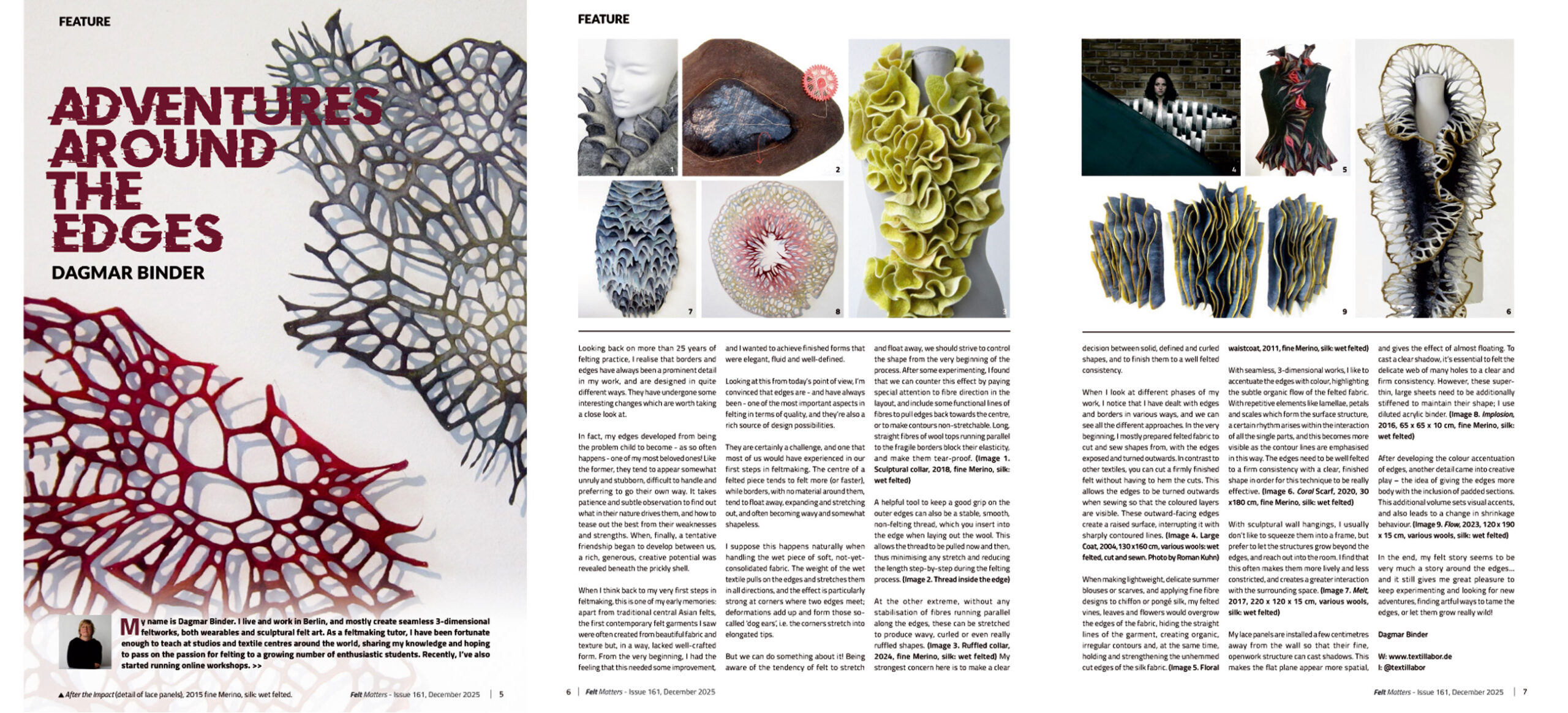
FELT MATTERS, issue 161, dec 2025, pp. 5-7
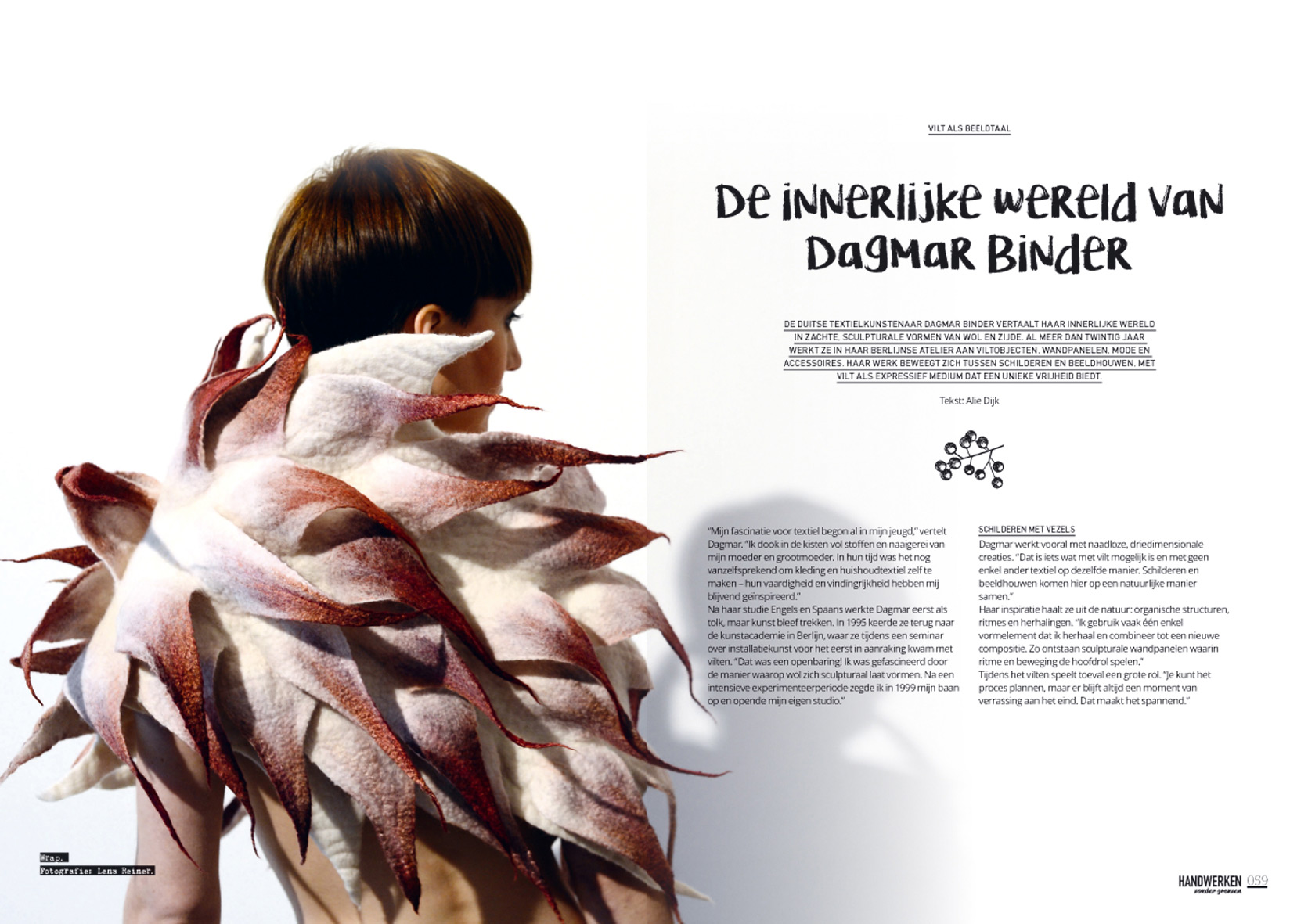
HANDWERKEN ZONDER GRENZEN, NL/BE Nr. 252 2025, page 58-61
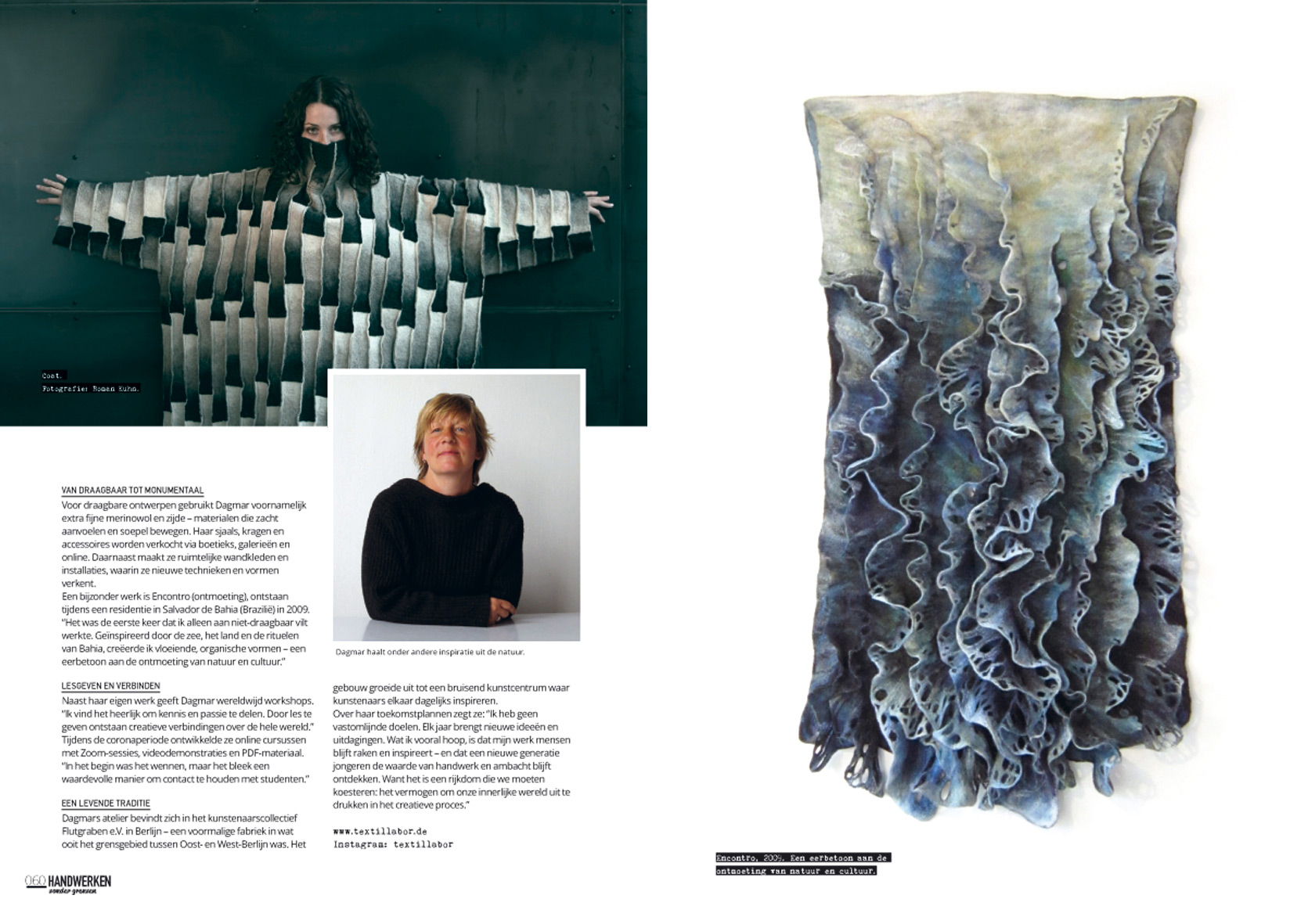
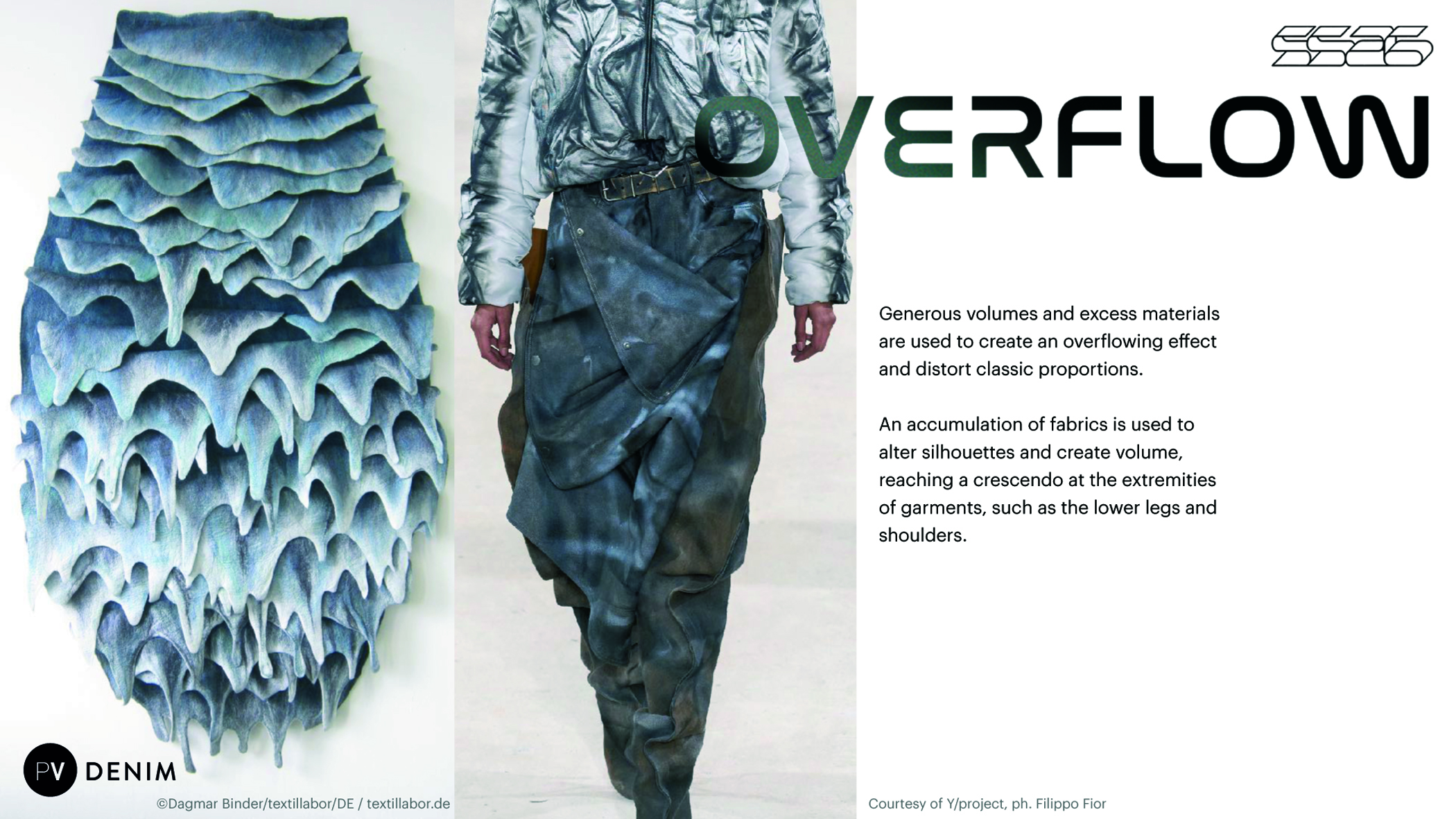
PREMIÉRE VISION, FR
FELT MATTERS, issue 161, dec 2025, pp. 5-7
HANDWERKEN ZONDER GRENZEN, NL/BE Nr. 252 2025, page 58-61
PREMIÉRE VISION, FR
In-person-workshops 2026
September 25-27, 2026 GRIMA meeting in Søgård/Denmark, grima.dk
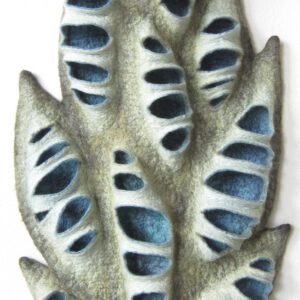
Sculptural wallhanging – Fossil leaf
In this workshop I’d like to introduce a way of creating an impressive structure for a sculptural wallhanging by incorporating a group of hollow chambers in a larger item. They can be opened later and shaped manually into an organic seamless felt object.
The silhouette of the sculpture will only arise from the arrangement of all individual parts.
We’d pay special attention to fibre combination and directions to connect all parts securely and prepare the material for specific shaping and deformations. With a well planned use of colour through all layers we can even increase the dimensional effect.
As an example I developed this fossil leaf project for you. It will allow us to discuss and practise all working steps included and enable you to apply the technique to a variety of individual felt works in the future.
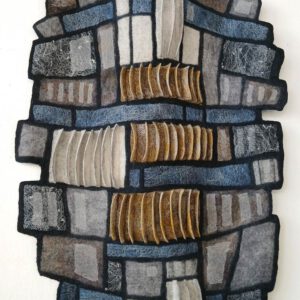
SCULPTURAL WALL HANGINGS – COLLAGES OF FLAT AND 3D COMPONENTS
October 18-24, 2026 at La Couech, Montbrun-Bocage/FR, feutreformationfrance.com
(students should have previous knowledge about the foundations of felting,
some experience of felting with resists can be helpful)
Wool as a fascinating natural, malleable material offers almost endless possibilities for sculptural creations. For each of my WALLHANGINGS workshops, I’m focussing on a specific theme, in order to examine the details of this particular approach in greater depth and take a close look at the technical details involved.
This year, under the general topic COLLAGES we want to design the surface of a felted wallhanging by combining flat and 3d-elements and fusing them into one seamless piece. Collages are a quiet playful and stimulating way of creating a work out of bits and pieces of a variety of materials. The result is usually open-ended, the final image only emerges during the process, by trying out different arrangements and carefully observing how the various fragments come together and interact with each other. This allows you to experiment with different wool types and textures and create out of them a work with individual style and esthetics.
In flat parts, fibers will have space to develop their beautiful structure, while the 3d sections will bring an additional contrast into the picture and give us the opportunity to look at some features of spatial felt forms as well. You will learn about composition and consistency of suitable handmade prefelts, possibilities for graphic and tactile surface texture, and finally assemble all fragments in a collage that will be firmly felted onto a thick, rather substancial base.
We will explore how different fibers can be used best in the felting process and how to emphasize their beauty and characteristics. In a former workshop in Montbrun we examined some typical regional wool types and can draw on some good examples in the material archive. Be aware though, coarse wools are suitable for the base and larger elements, for fine and small scale details you will need to use fine fibers. (See more details in the material list.)
With the group, we will keep an eye on the individual projects evolving and point out technical details, so you can observe and learn a lot from various situations in the lively felting process.
I’m looking forward to a new creative challenge and inspirational workshop week with you!
For enrolment, please contact Krystel & Jean Francois Chavigny at Atelier La Couech